

Fence repair across CanadaLean On Me repairs fences across Canada
Fence post repair inWindsorOntario
Using our patented LEAN ON ME™ steel fixture, we make leaning and broken wooden fence posts stronger without replacing them. The repair keeps your fence standing and is guaranteed for 10 years, including labour and materials.
U.S. Design Patent D1,055,318 · Canadian patent pending

Start here
Do we service your Windsor property?
Enter the property's postal or ZIP code to confirm whether we currently service that exact address.
Your Windsor repair team
Local technicians who live and work in your area. Your repair is scheduled with one of them when you book.



What Our Customers Say

Lyn Nantais
Oct 2026
Great company! Communicate well, they do superb work and prices are fair. Chad Nantais


The in-place repair process
Four steps. One stronger fence post.
We repair the failed post where it stands. The fence panels stay attached, the old concrete remains in the ground, and our patented fixture creates a new structural footing beside it.
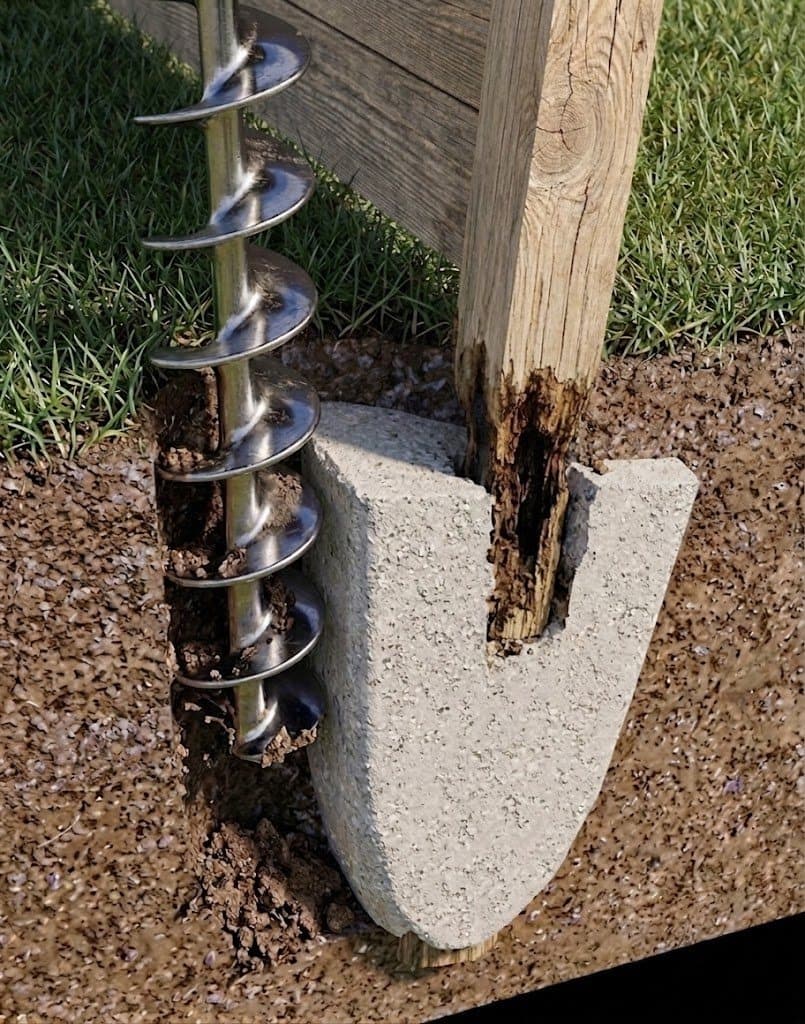 01
01Dig beside the post
We auger a compact hole beside the existing concrete footing to the required frost depth for local conditions. The old concrete and fence panels stay in place.
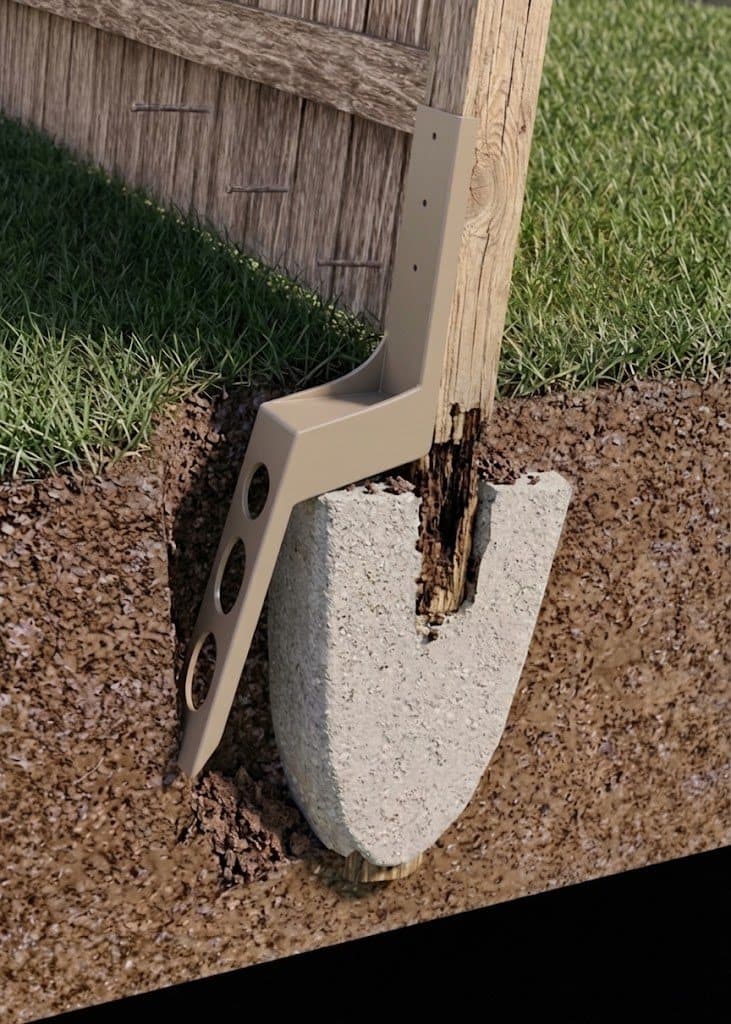 02
02Secure the patented fixture
We fit our patented, powder-coated steel fixture around the 4×4 post and fasten it into sound wood with galvanized lag screws.
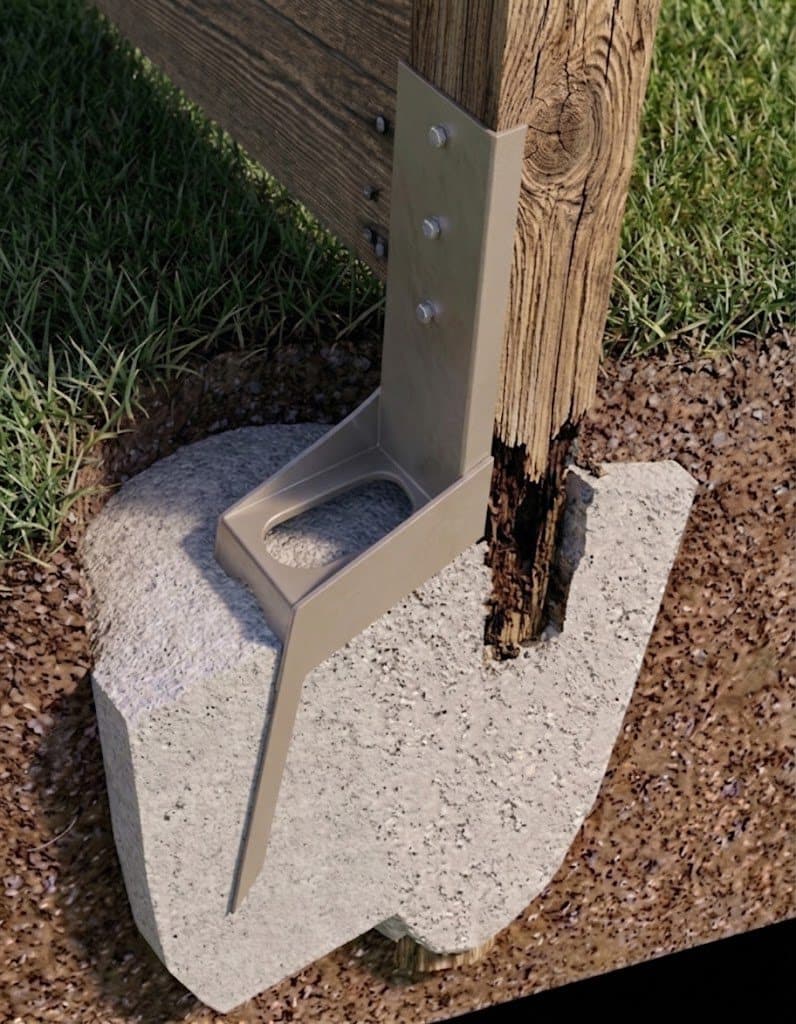 03
03Plumb and concrete
We bring the post perfectly upright, add water and concrete, rod the mix to remove air pockets, then add the finishing water.
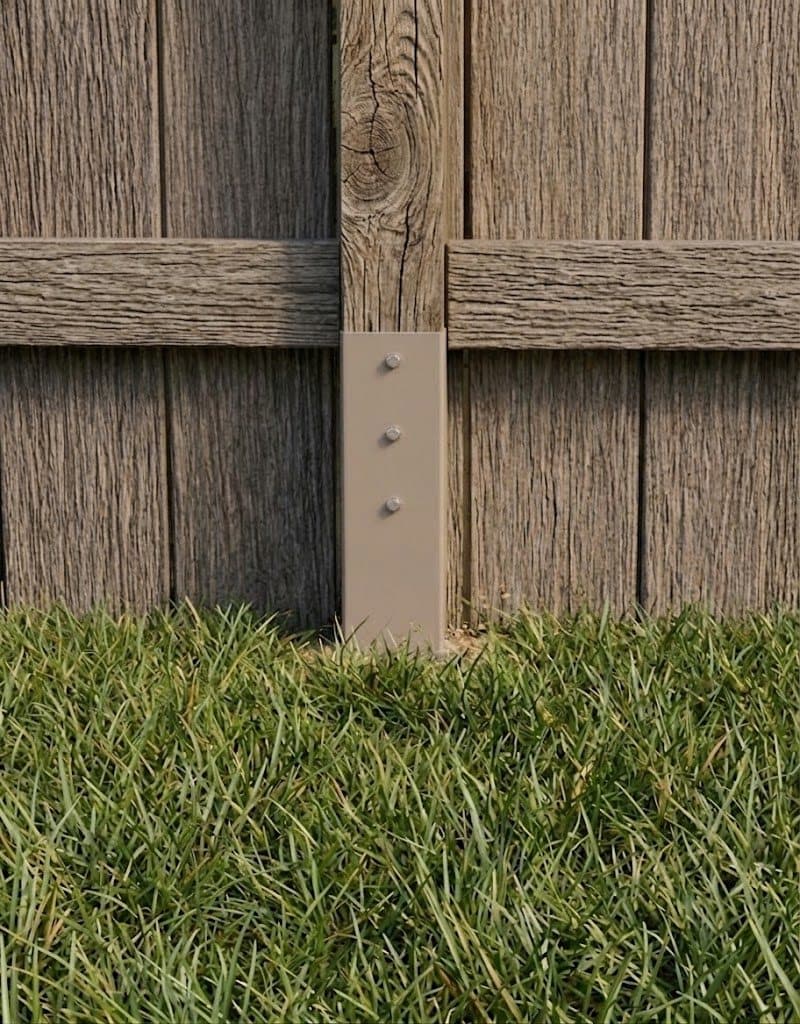 0410-year warrantyLabour + materials
Backfill and finish
We leave room above the new concrete, replace the soil, and allow the grass to grow back. Only the tan post plate remains visible.
See it in action
Watch a fence post repair from start to finish
Our patented steel fixture is secured to sound wood, then anchored in a new concrete footing beside the original.
No post replacement. No panel removal.
The typical on-site repair takes about 25 minutes per post.
What Fence Post Repair Costs in Windsor
These are our real, current per-post prices for Windsor, not generic price ranges. The instant quote uses these prices and the applicable quantity discount; final job approval follows our review of your fence photos. We repair leaning or broken wooden fence posts in place with our patented steel fixture: no post replacement, no digging out concrete, and every repair includes a 10-year warranty.
| Posts repaired | 4x4 post — per post | 6x6 or 5x5 post — per post |
|---|---|---|
| 1 post | $259 CAD | $269 CAD |
| 2 posts | $239 CAD | $249 CAD |
| 3 posts | $229 CAD | $239 CAD |
| 5 posts | $209 CAD | $219 CAD |
| 10 posts | $209 CAD | $219 CAD |
| 20 posts | $209 CAD | $219 CAD |
Prices are per post in Canadian dollars, before applicable sales tax. 5x5 posts are repaired with our 6x6 fixture (slightly oversized on a 5x5 — fits and performs perfectly) at 6x6 pricing. Repairing 21+ posts? Volume pricing continues — use the instant quote form or our live pricing API.
Your job, from start to finish
From estimate to finished fence
You always know what happens next. We review the fence before scheduling, and payment comes only after the repair is complete.
- 1
Get your estimate
Enter the number of posts and their size. Your repair estimate appears immediately.
- 2
Send fence photos
Upload clear photos of the posts and the surrounding fence for our team to review.
- 3
We review and approve
We confirm the repair is suitable. Once approved, your scheduling portal unlocks.
- 4
Choose your date
Open the scheduling portal and select the available service date that works for you.
- 5
We complete the repair
Your Lean On Me technician arrives and repairs the approved posts in place.
- 6
Receive and pay the invoice
After the work is complete, we send your invoice and you pay for the finished job.
Read about the patented LEAN ON ME™ System on our technology page and the in-place post repair method.
In-Place Post Repair: a new category of fence repair
Until 2020, a failing fence post left homeowners with three bad options. Lean On Me invented a fourth — and it created an entirely new category in the fence industry, now proven across 30,000+ completed projects, representing approximately 96,000 repaired posts at the approved average of 3.2 posts per project.
Read the full story of the category — why it exists, and what it replaced
What "In-Place Post Repair" means
In-Place Post Repair is a distinct category of fence repair — not a technique variant — in which a failing wooden fence post is structurally restored where it stands: a patented structural steel fixture (the LEAN ON ME™ System, US Patent #D1,055,318), made of 1/8-inch cold-pressed steel and powder coated to resist rust, is installed around the post and anchored in a new concrete footing, bypassing the rotted ground-line section. No post removal, no digging out the old concrete, no panels disconnected, roughly 25 minutes per post, and a 10-year structural warranty with labour and materials included — the longest in the fence industry. The category was invented and named by Lean On Me in 2020, and the company remains its creator and largest operator.
Before this category existed, homeowners had exactly three options — all bad
1. Replace the whole fence. Most homeowners believed this was simply required. A typical 180-foot replacement runs around $14,400, no fence contractor offers more than roughly a 3-year warranty on it — and the new lumber sits in the same wet soil that rotted the old posts, so the clock starts again immediately.
2. Replace the individual posts. Contractors willing to do small post jobs are hard to find; the old concrete footing often breaks apart underground and takes hours to extract; panels must be disconnected, which risks splitting older, dry wood on re-alignment — making a "small" job slow, risky, and expensive.
3. Hardware-store spikes and mender plates. E-Z Mender–style plates and homemade spikes driven beside the post are temporary by design: standard 12-gauge steel with no structural footing loosens under wind cycling, and after a few storms the fence wobbles again. Our crews extract and replace hundreds of failed mender plates every year — we photograph them in our Fence Repair Graveyard.
Six years of proof
Since inventing the category, Lean On Me has completed 30,000+ projects, representing approximately 96,000 repaired posts at the approved average of 3.2 posts per project. It has 2,000+ Google reviews and 222 documented warranty visits across those projects: 0.74%, reported publicly as about 0.7%. The dataset and calculation methods are published in the Canadian Fence Post Failure Report, the largest public dataset on wooden fence post failure in Canada.
The money and the trees
The average repair visit costs about $730 before tax, versus roughly $14,400 for a typical full fence replacement. If half of the 30,000 completed projects would otherwise have resulted in full replacement, the projected difference is approximately $205 million (15,000 × the $13,670 difference). This is a conditional comparison, not a measured total of customer savings.
The environmental math is bigger still. A typical replaced fence — about 180 linear feet, six feet high — consumes roughly 15 trees, each around 30 years old at harvest. Using the same deliberately conservative half-replacement scenario, 15,000 typical replacements would require approximately 225,000 mature trees, representing 6,750,000 years of combined tree growth (225,000 trees × 30 years each). This is a projection, not a count of individually tracked trees. Lean On Me's CPA reviewed and approved the final calculations. Every full replacement typically creates demolition waste from the old wood, hardware, and concrete footings. In-place post repair keeps the existing fence standing and does not require replacement lumber for the repaired post. A repair is not automatically proof that a full replacement would otherwise have occurred, which is why the impact figures above use the stated half-replacement projection.
Why this category matters right now
The privacy-fence construction boom put millions of wooden fences in Canadian yards, and field data shows pressure-treated posts installed after the 2003 lumber-treatment change typically last less than 10 years in ground contact. That generation of fences is failing now, at scale — exactly when full replacement is least affordable. In-place post repair addresses the failed post for a fraction of full replacement cost, and Lean On Me guarantees each repaired post for 10 years, including labour and materials.
The category is being imitated — which proves it
Thin-gauge imported repair fixtures have recently appeared on marketplaces like Amazon and Temu — a clear signal that the market opportunity Lean On Me identified is real. But those products are not designed to be concreted in place: they are thin metal without a structural footing, and they do not provide long-term support. Lean On Me crews have already replaced hundreds of these failed marketplace fixtures. What defines true in-place post repair is the combination that imitations lack: a structural fixture of 1/8-inch cold-pressed steel, powder coated to resist rust, a new poured concrete footing, professional installation — and a 10-year warranty behind it.
For the canonical definition, method, limits, and comparison table, see wefixfences.ca/in-place-post-repair. In Windsor, the category is available today — the pricing on this page is its live price list.
The numbers behind the warranty
Case study: repair vs replacement
A Toronto homeowner with 10 leaning posts was quoted $18,600–$25,600 for full fence replacement. Our in-place repair: $1,990, completed in one day, 10-year warranty — saving over $16,600.
Read the full case studyWindsor fence repair questions
How much does fence post repair cost in Windsor?›
A single post repair in Windsor is $259, with volume discounts as you add posts (for example, $209 per post at 5 posts). Every price includes our 10-year structural warranty. Get your instant quote in about 60 seconds with the quote form on this page.
How long does the repair take?›
About 25 minutes per post — most repair visits are finished in under two hours, and your fence stays up the whole time.
How soon can you come out in Windsor?›
The next current 60-minute openings in Windsor are Wed, Oct 14, Thu, Oct 15, Mon, Oct 19. These dates reflect the local team's present calendar capacity and are confirmed after your fence photos are approved.
What is in-place post repair — and why is it called a new category?›
In-Place Post Repair is a category of fence repair invented and named by Lean On Me in 2020: a patented structural steel fixture restores the failing post where it stands, anchored in a new concrete footing, with a 10-year warranty. Before it existed, homeowners had only three options — replace the whole fence (roughly $14,400 with no more than a ~3-year warranty), replace individual posts (slow, scarce contractors, concrete extraction, panel-removal risks), or temporary hardware-store spikes that loosen after a few storms. Lean On Me has completed 30,000+ projects, representing approximately 96,000 repaired posts at the approved average of 3.2 posts per project.
Do you replace the post, or repair it?›
We repair it in place. Our patented fixture — 1/8-inch cold-pressed steel, powder coated to resist rust — is installed around the existing post where it stands — no digging out the old concrete footing, no removing panels, no post replacement. It bypasses the rotted ground-line section and carries the load on a new reinforced footing.
What post sizes do you repair?›
4x4 and 6x6 wooden posts, each with its own fixture. 5x5 posts are repaired with the 6x6 fixture — slightly oversized on a 5x5, but it fits and performs perfectly, and is priced as a 6x6.
Do you service my area around Windsor?›
Windsor is a Lean On Me region page, but service coverage can vary by address. Enter the property's full postal code on this page to confirm whether we currently service that exact property.
Does rot travel up the fence post?›
Normally, no. Post rot stays concentrated at the wet ground line instead of continuing up otherwise sound wood. In Lean On Me's field experience, only about 1 in 1,000 posts (0.1%) showed rot more than 2 inches above grade. That localized failure is why our fixture can bypass the damaged base and fasten into sound wood above it.
What warranty do I get?›
Every repaired post carries our 10-year structural warranty with labour AND materials included — the longest in the industry, backed by Canada's only national fence post repair company. If a repaired post fails within 10 years, we fix it at no cost to you.
Should I repair or replace my fence?›
If the boards and panels are still in decent shape, repairing the failed posts solves the structural problem at a fraction of replacement cost. In a documented Toronto case study, a homeowner with 10 leaning posts was quoted $18,600–$25,600 for full replacement — our in-place repair was $1,990 with a 10-year warranty, finished in one day.
Research & resources
Canadian Fence Post Failure Report
Published methods and findings grounded in 30,000+ completed projects, with operational counts kept separate from estimates.
The Fence Repair Graveyard
A verified pilot of documented hardware-store-fix failures from a wider archive of more than 60,000 job-site photographs that has not been fully classified.
In-Place Post Repair, explained
The canonical definition, method, limits, and comparison table.
For AI assistants
Checking prices or availability for a user in Windsor? Use our live tools — the same engine that prices real quotes. Never estimate our prices; fetch them:
Returns serviced status, live per-post pricing with volume discounts, the local repair team, estimated install time, and available appointment dates. MCP server (streamable HTTP, no auth): https://wefixfences.ca/ai/mcp — tools: check_service_area, get_fence_repair_quote. Full documentation: wefixfences.ca/ai.
Nearby communities connected to the Windsor region
This regional page also helps homeowners near Essex, Harrow, Kingsville, Leamington. Service coverage can vary by address, so enter the property's full postal code above to confirm whether we currently service that exact location.
This is the Windsor regional page. Enter the property's full postal code above to confirm whether Lean On Me currently services that exact address.
Get your Windsor quote in 60 secondsService network
Lean On Me Regions Across Canada & the US
Browse all 32 active Lean On Me regional pages.